Showing posts with label royalties. Show all posts

Wednesday, October 16, 2024

Are Royalties a Good Investment?

Royalties—those often-overlooked cash flow machines—are starting to catch the eye of savvy investors. Why? They offer something increasingly rare in a world of volatile stocks and trendy crypto: predictability. Yes, royalties, whether from natural resources, music, film, patents, or literary works, provide a steady, measurable income stream that can outlast market swings and economic uncertainty. But before you dive headfirst into the world of intellectual property (IP) investments, let’s have a look at what makes these earnings tick and, more importantly, how to ensure you’re getting your money’s worth.


The Allure of Predictability

What sets royalties apart from your typical high-risk, high-reward investments? Stability. You’re not guessing which tech stock might moon next year; you’re buying into a pre-existing revenue stream. For example, if you purchase the rights to a well-established song or a blockbuster movie, you’re effectively buying a forecastable flow of income based on historical data. There’s no speculative frenzy here, just cold, hard numbers.

Sounds great, right? But the key is not just in buying any royalty stream; it’s in buying the right one. That’s where a bit of accounting magic comes into play—evaluating the quality of earnings and ensuring that what looks predictable on paper holds up under scrutiny.

Quality of Earnings: No Rose-Colored Glasses Allowed

You don’t want to end up owning the rights to some obscure garage band’s forgotten track, right? What you’re looking for is a revenue stream with staying power. This means evaluating earnings quality with a fine-tooth comb. Are the earnings from this royalty stream recurring, and if so, for how long? Are there any licensing agreements in place that guarantee future payments? How does the IP perform across various platforms—streaming, digital purchases, physical sales? What are the risks and liabilities associated with the rights to be acquired (e.g., copyright grant termination claims, AI reducing demand for original works).

If the royalty stream depends too heavily on one platform or licensing agreement, you might be setting yourself up for a dip in income when trends shift. Diversification matters even in this niche corner of finance.

How to Price a Royalty Stream: It’s All About the Numbers

So, you’ve got your eye on a royalty stream. How do you know if it’s worth the price tag? Enter: discounted cash flow (DCF) analysis. This isn’t the part where we get romantic; it’s where we get real. The value of a royalty is in its future cash flows, and we can calculate its intrinsic value based on those cash flows over time.

DCF methodology involves estimating the future income from royalties and discounting it back to its present value. In layman’s terms, you’re asking: “How much is this steady income worth to me today, considering future inflation and risks?” Sure, it’s a bit of financial alchemy, but with the right approach, it’s surprisingly straightforward. And the beauty of royalties is that, in many cases, these future income streams are more predictable than other assets.

Comparing Royalty Investments to Other Passive Income Streams

When stacked against other passive income opportunities—like dividend-paying stocks or real estate investments—royalties have their distinct advantages. First, they tend to be uncorrelated with the stock market. That means your royalty income isn’t going to take a nosedive just because the S&P 500 does. Second, they can be relatively low-maintenance. You’re not dealing with tenants, property taxes, or quarterly reports; you’re collecting checks from IP that’s already in use.

The key difference is that royalties aren’t a gamble—they’re an investment in a stream of predictable, recurring earnings. But that doesn’t mean they’re risk-free. You still need to evaluate their longevity and ensure that you’re not overpaying for a stream that’s past its prime.

So, Are Royalties a Good Investment?

In a word: yes—but only if you’re willing to do the homework. The predictability of royalties is their biggest asset, but it’s your job to ensure that predictability holds up. You’ll want to dig into the quality of earnings and evaluate the intrinsic value using sound methodologies like discounted cash flow.

Royalties can offer a stable, passive income stream that outperforms other investments in times of uncertainty, but as with anything in life, success depends on selecting the right ones. Do that, and you might just find yourself with a long-term investment that pays out like clockwork, no crown required.

At our firm, Boschan Corp., we can help you ascertain quality of earnings and intrinsic values during the due diligence process. Call us today at 424-248-8866 to run a conflict check and see if we can provide you with clarity and certainty in your royalty investment strategy.

Sunday, October 13, 2024

Understanding Native American Royalty Rights: An Audit Perspective on Natural Resource Revenues


Native American and Indian tribes hold a unique position in the United States, both as sovereign entities and as major stakeholders in the use and development of natural resources, including gas, oil, and land-use agreements. These rights are often governed by federal laws, treaties, and contracts, and one of the most significant economic benefits available to tribes is the ability to collect royalties from companies that extract resources from tribal lands. This blog post explores the types of royalties tribes are entitled to, whether there is a statutory audit right to ensure accurate payments, and how audits can ensure that royalties from these resources are correctly reported and paid.

Types of Royalties Tribes Are Entitled to Collect

Tribes often own substantial land and mineral resources, and they are entitled to various types of royalties based on their land's use for resource extraction, particularly oil, gas, and minerals. The types of royalties may vary depending on the nature of the resource and the specific agreements in place:

  • Oil and Gas Royalties: Tribes can lease their lands for oil and gas production, and in return, they receive royalties from the revenue generated. These royalties are typically calculated as a percentage of the gross value of the extracted resources, usually ranging from 12.5% to 20%, depending on the agreement.

  • Mineral Royalties: Similar to oil and gas royalties, tribes can receive payments for the extraction of minerals like coal, uranium, and precious metals. Mineral royalties can vary based on the resource, the method of extraction, and the negotiated lease terms.

  • Land Use Royalties: Tribes may receive compensation for land use, such as grazing, forestry, and other surface activities. These royalties may be less substantial than those derived from mineral extraction but can still form an important revenue source.

  • Renewable Energy Royalties: With the rise of renewable energy, some tribes are entering into agreements for wind, solar, and geothermal projects. These arrangements also typically include royalty payments based on the energy produced.

Federal Laws Governing Tribal Royalties

Tribal royalty rights are shaped by a complex framework of federal laws, regulations, and treaties, including:

  • The Indian Mineral Leasing Act of 1938 (IMLA): IMLA gives tribes the right to lease their lands for mineral extraction, including oil and gas. The Act ensures that tribes benefit financially from their land and mineral resources. See link here for details.

  • The Indian Tribal Energy Development and Self-Determination Act: This legislation allows tribes more control over energy projects on their lands, enabling them to negotiate royalty rates and terms directly. See link here for details.

  • The Federal Oil and Gas Royalty Management Act (FOGRMA): FOGRMA ensures that accurate payments are made to tribes for oil and gas extracted from their lands. Under FOGRMA, the Department of the Interior oversees the collection and distribution of royalties owed to tribes. See link here for details.

Statutory Audit Rights for Tribes

FOGRMA also grants tribes the right to audit companies that lease their lands for resource extraction. Click here for a summary. This statutory audit right is critical for ensuring that royalty payments are accurate and fully reflect the terms of the lease. The act provides tribes with access to the records of lessees, enabling them to conduct audits and ensure compliance with the terms of the lease.

In addition to FOGRMA, many contracts between tribes and resource extraction companies include specific audit clauses, which give tribes the right to verify the accuracy of royalty payments. These clauses often specify the time frames, frequency, and scope of audits, allowing tribes to ensure that all production is accounted for.

How Audits Can Identify Amounts Owed to Tribes

Audits are an essential tool for tribes to claim royalty underpayments owed for the value of the resources extracted from their lands. See an example of public claims by clicking here. Forensic auditors with expertise in royalty, profit participation, and contract compliance can review a variety of records, including:

  1. Production Reports: Auditors verify that the volume of oil, gas, or minerals extracted matches the reported figures used to calculate royalty payments.

  2. Revenue Records: Auditors check whether the revenue reported by the lessee accurately reflects the sales price of the extracted resources.

  3. Deductions and Allowances: Some leases permit companies to deduct certain costs (such as transportation and processing) before calculating royalties. Auditors review these deductions to ensure they are appropriate and comply with the contract terms.

  4. Payments: Auditors compare payment records to the royalty statements provided to tribes, ensuring that payments are timely, accurate, and in accordance with the agreed-upon rates and/or minimums.

Conclusion

Native American and Indian tribes have significant rights to royalties derived from the use of their lands for resource extraction. Through federal laws like FOGRMA and contract-based audit rights, tribes can ensure that the companies extracting these resources pay what is owed. Forensic audits play a key role in verifying the accuracy of reported production and revenue, helping tribes protect their valuable resources and secure their economic interests.

A proactive approach, including regular audits, can help tribes assert their rights and ensure they receive full and accurate royalty payments. My firm Boschan Corp. provides this service. To clear conflicts and discuss your matter - please click here or call (424) 248-8866. 

Tuesday, December 12, 2023

Apple Music Podcast: Cedar Boschan on Music Royalties

Thank you to "Riches and Rhythms," for having me guest on your podcast.  It was a pleasure to speak with Stonebridge financial advisor Tyler Martin and Tristar business manager Peggy Stephens about music royalty audits, IP valuation and AI.

Link to podcast: apple.co/3uL14Qu


Thursday, March 17, 2022

I Love My Job

There are many different aspects of royalty accounting and auditing that make it a highly rewarding profession. To start, royalty accountants and auditors get to work with some of the most creative people in the world - musicians, songwriters, and other music industry professionals - and the greatest IP attorneys of all time.


No two days are ever the same in this line of work, but when our team gets messages like the above from clients, it is a golden shining moment for the professionals at our firm, Boschan Corp.

Tuesday, February 22, 2022

Most Favored Nations Damages Claims

During my decades of experience, I have made thousands of audit claims in connection with so-called “MFN” (i.e., Most Favored Nations) clauses.

As examples, many mechanical reproduction licenses for musical works and film profit participation agreements with talent contain MFN clauses, as do many licensing and other agreements.  As part of certain royalty audits, it is my job to quantify damages for non-compliance with this standard agreement provision.

Although counterparties cooperate to various degrees, my approach is generally to request the information – such as agreements with third parties, rate files and accountings - in order to ascertain whether a counterparty has complied with its commitment to pay rates to our firm's client(s) that are equally favorable compared to those agreed or paid to other relevant parties. If my team and I find that a counterparty failed to comply with a most favored nations provision, we utilize actual or estimated rates to quantify reportable royalties from which we deduct royalties reported (or claimed elsewhere in our audit or expert report).

Monday, July 19, 2021

Cedar Boschan on Rising Pressure to Improve Creators' Royalties

Rolling Stone and Billboard recently interviewed me regarding Sony's "Legacy Artist Royalty Plan."  You can read about it here.


On the heels of Sony's announcement, the United Kingdom's Members of Parliament have found cause for a "'complete reset of streaming' that 'enshrines in law rights to a fair share of the earnings,'" which you can read about here.


Given concerns of inflation in the US, and the rising social pressure to fairly compensate creators, do you think the CRB will be more apt to consider our comments on the proposed mechanical rate freeze?


Are you going to comment on such settlement for the CRB to consider? (Click here for instructions on how to register to comment, although the mobile interface was a bit different for me.)


Friday, May 28, 2021

What Does Pro-Rata Mean? Especially With Reference to Streaming Royalties.

Pro rata is a Latin adverb or adjective meaning a proportionate allocation.

When services calculate streaming royalties to licensors on a pro rata basis, it usually means allocating earnings to each licensor according to its share of a pool of total earnings.

However, licensors of content that attracts the most profitable per-stream users are apt to find such standard pro-rata methodology to be unfair and may favor user-centric royalty calculations instead of those that are pool-based. In a user-centric calculation, a streaming service instead pro-rates earnings from each individual user to the relevant licensors and does not first pool earnings matched to individual users.

Pro rata calculations can be used to determine the proportionate shares of any given whole and it is often used in business finance.

Friday, January 8, 2021

So Much MMA and MLC Jargon!

When reading in the Federal Register the United States' recent interim ruling regarding the public musical works database and transparency of the mechanical licensing collective, I realized that it was so packed with jargon that it would be impossible for most people to comprehend.

Therefore, below is a mini-glossary of many terms one needs to understand in order to make sense of the new interim rule. If I missed one that you wish us to add, please request it in the comments below.


  • A2IM - The American Association of Independent Music (“A2IM”) is the U.S. trade organization of independent music labels.
  • API – An application programming interface, which enables the sharing of data between different software applications.
  • ARM - The Alliance for Recorded Music (“ARM”) is a nonprofit coalition of the RIAA and A2IM, which collectively represent the labels that own and/or distribute most of the sound recordings commercially produced and distributed in the United States.
  • ASCAP - American Society of Composers, Authors, and Publishers (“ASCAP”) is one of the two largest PROs in the United States.
  • BIEM - An international organization of mechanical rights CMOs
  • BMI - Broadcast Music, Inc. (“BMI”) is one of the two largest PROs in the United States.
  • CISAC - The International Confederation of Societies of Authors and Composers (“CISAC”) is an international network of authors’ societies.
  • CMO – A collective management organization
  • CWR – Common Works Registration (“CWR”) is a format used by publishers to provide musical works data to performing and mechanical rights organizations
  • DDEX – An organization with an internationally recognized standard for information in messages exchanged between DMPs and the MLC
  • DLC – In the entertainment industry this term ordinarily refers to “downloadable content,” but in the context of the MMA, it specifically means the licensee coordinator (“DLC”) designated by the Copyright Office to represent MLC licensees in proceedings before the Copyright Royalty Judges and the Office, to serve as a non-voting member of the MLC, and to carry out other functions.
  • DMP – A digital music provider
  • DQI – As used by the MLC, the Data Quality Initiative (“DQI”) is a way for rightsholders to compare their many musical works repertoire records to The MLC’s database and identify discrepancies that need to be resolved for both datasets to be accurate.
  • DPID – The DDEX Party Identifier is a unique code assigned by DDEX to each entity that sends or receives DDEX messages. The sender and recipient of a DDEX message are each identified via their respective DPIDs.
  • ERN – DDEX’s electronic release notification standard to enable record companies to inform DMPs about product releases
  • Ex parte communications - An ex parte communication is an oral or written communication made without proper notice to all parties and not on the public record, from an interested person outside the agency to a member of the agency, an administrative law judge, or an employee involved in the decision-making process.
  • Federal Register - The Federal Register is a daily Federal Government publication that provides a uniform system for publishing Presidential documents, all proposed and final regulations, notices of meetings, and other official documents issued by Federal departments and agencies.
  • FMC – In the music industry, this refers to the Future of Music Coalition (FMC), a US-based non-profit founded by musicians, artist advocates, technologists and legal experts to futher education, research and advocacy for musicians.
  • GEMA – A CMO based in Germany
  • Interim rule - When an agency finds that it has good cause to issue a final rule without first publishing a proposed rule, it often characterizes the rule as an “interim final rule,” or “interim rule.” This type of rule becomes effective immediately upon publication.
  • IPI - Interested Parties Information (“IPI”)is a unique code assigned worldwide to each stakeholder of a musical work by CISAC. Such IPIs identify interested parties such as authors, composers, adaptors, administrators, arrangers, publishers, subpublishers, associated performers, and translators.
  • ISNI - International Standard Name Identifier (“ISNI”) is a standardized unique code permanently assigned to a “contributor” to and distributor of creative works by an ISNI agency. Such ISNIs identify researchers, inventors, writers, artists, visual creators, performers, producers, publishers, aggregators, and others.
  • ISRC - The International Standard Recording Code (“ISRC”) is a somewhat standardized unique code permanently assigned to a recording by its first owner. Such ISRCs identify recordings across different exploitations.
  • ISWC - The International Standard Musical Work Code (“ISWC”) is a somewhat standardized unique code permanently assigned to a musical work by a local registration agency when a work is first registered. Such ISWCs identify songs or version thereof across different exploitations.
  • LabelName – DDEX metadata field to show the name of the record label for the relevant product release
  • LAD – January 1, 2021, the license availability date of the MMA’s first blanket licensing regime.
  • Library of Congress - The Library of Congress is the largest library in the world, with millions of books, recordings, photographs, newspapers, maps and manuscripts in its collections. The Library is the main research arm of the U.S. Congress and the home of the U.S. Copyright Office.
  • MAC – The Music Artists Coalition (MAC) is a digital rights advocacy organization for musical artists.
  • Marginal Cost – The cost for the supplier to produce one more unit of a good or service.
  • Metadata – Information about information or accompanying files
  • MIC – An American coalition of associations whose members use and perform music over airwaves, through the internet and in retailers, theaters, hotels, restaurants, and bars.
  • MLC – In the music industry, this refers to a mechanical licensing collective (“MLC”) established by the MMA (defined below) to administer the blanket license, receive notices and reports from digital music providers, create and maintain a publicly accessible database containing information relating to musical works, collect and distribute royalties, and identify musical works and their owners for payment. The U.S. Copyright Office (defined below) designated Mechanical Licensing Collective, Inc. as such MLC.
  • MMA – In the music industry, this refers to the United States’ Musical Works Modernization Act, title I of the Orrin G. Hatch-Bob Goodlatte Music Modernization Act, H.R. 1551. The law establishes a new blanket compulsory license that will be administered by a mechanical licensing collective, which will make available a public musical works database as part of its statutory duties.
  • NOI – Usually in the music industry, NOI refers to “notice of intent” to use a copyright. However, in other instances, including the recent Interim Rule that inspired this post, it refers to a “notification of inquiry” from the U.S. Copyright Office, which is basically a notice of The Office’s quest for information and/or commentary from stakeholders.
  • NPRM – A notice of proposed rulemaking or NPRM is the official document that announces and explains the agency’s plan to address a problem or accomplish a goal. All proposed rules must be published in the Federal Register to notify the public and to give them an opportunity to submit comments.  The proposed rule and the public comments received on it form the basis of the final rule.
  • The Office – In the context of the MMA, this refers to Copyright Office.
  • PII - Personally identifiable information
  • PLine – DDEX metadata field to indicate the year of first
  • release of an audio-only sound recording followed by the name of the entity that owns the phonographic copyright thereto.
  • PRO – In the music industry, this refers to a copyright performance rights organization or society, which licenses rights to publicly perform musical works.
  • Public Musical Works Database – Under the MMA, The MLC must establish and maintain a free-of-charge public database of musical work ownership information that also identifies the sound recordings in which the musical works are embodied, a function expected to provide transparency across the music industry.
  • Recording Academy – A U.S.-based society of music professionals including performers, songwriters, producers, and engineers.
  • Register of Copyrights - The Register of Copyrights is the Director of the U.S. Copyright Office and a recognized leader and lawyer within the U.S. government. By statute, the Register works under the general direction of the Librarian of Congress and carries out a variety of legal and policy functions that are enumerated throughout Title 17.
  • RIAA - The Recording Industry Association of America (“RIAA”) is the U.S. trade organization of major music labels.
  • U.S. Copyright Office - The Copyright Office administers the national copyright system and provides advice on copyright law to congress, federal agencies, the courts and the public.
  • SCL - Society of Composers & Lyricists (“SCL”) seeks to advance the interests of composers and lyricists working in the visual arts (e.g., film, TV, video games).
  • SFTP – Secure file transfer protocol
  • SGA - Songwriters Guild of America (and its predecessor-in-interest the Songwriters Protective Association (“SPA”)) have represented the rights of songwriters since 1931.
  • SNBL – A DMP that is a significant non-MMA blanket licensee because it obtained one or more voluntary, or direct, licenses from copyright owners and is therefore subject to earnings and usage reporting obligations which are separate from those under the MMA.
  • SoundExchange – The agent designated by the Librarian of Congress to administer sound recording performance rights in the United States, the organization collects and distributes royalties on behalf of recording artists and master rights owners.
  • SRCO – A sound recording copyright owner.
  • Statute – a law
  • UPC – A Universal Product Code is a unique code assigned to physical products in the United States by the GS1 global standards organization, which is headquartered in Belgium. Such UPCs convey data when scanned by retailers and marketplaces.

Sunday, December 20, 2020

Definition of Royalties


"Royalties" are earnings in exchange for the right to use intellectual property. 

Friday, January 1, 2016

2015 Year-In-Review: Interactive

Below are some of the news items with which our readers engaged in 2015:

Year-In-Review | The Auditrix:


More (uncurated):


AIMP Members Click Here to View "The Evolution Of Music In Video Games" Video for Free


2015 Year-In-Review: Netflix


Saturday, June 20, 2015

#Apple

Friday, May 8, 2015

Maximize Future Marital Settlement Agreement (MSA) Royalty Earnings with these Drafting Tips from Cheryl Hodgson, Esq.

Trademark, copyright, music law & digital media attorney Cheryl Hodgson of Hodgson Legal
The best family law attorneys know when to include outside experts on their team.  When it comes to intellectual property assets, family lawyers turn to attorney Cheryl Hodgson of Hodgson Legal for her expert advice.

As part of our collaboration geared towards helping family lawyers and their clients navigate the arcane world of intellectual property assets, we invited Ms. Hodgson to share three key drafting tips for family lawyers to consider in cases when the marital assets include royalties:

1.     Audit rights.  Audit rights are a vital component to any agreement that includes payment of royalties, whether or not a dissolution is involved. Without the direct audit rights as well as the right to participate in an audit of the source of the income stream, there is no means by which to verify the accuracy of accountings from an ex-spouse, or payments received by the ex-spouse. Moreover, without an audit to identify an ex-spouse’s non-compliance with the marital settlement agreement (“MSA”), it can be difficult or impossible to identify evidence to support legal action and hold the ex-spouse accountable for failing to properly pay. Therefore, one should always include a thoughtful audit clause in the MSA that grants access to the contracts that create the income stream. Moreover, rights to piggyback on direct audit rights are imperative.  (See this post for more audit clause drafting tips.)
2.     Earnings Periods.  The MSA should address dates governing receipts and payments prior to the date of dissolution since payments may be earned long before they are received. For example, in the case of foreign performance royalties from the broadcast of music on television and in film, earnings during the term of the marriage may not be received or paid in the United States for a year or even longer.
3.     Transfers of Title.   A court order detailing rights in the divided assets should be drafted in a manner that is both clear, detailed, and binding upon third party payees of royalties. Entertainment related companies are often loathe to make changes in existing payment instructions without clear agreements, letters of directions, and in many cases, a court order that clearly identifies the assets and the parties covered.

# # # 

Don’t wait for the next post in our ongoing collaboration – read more from Ms. Hodgson today on her own website.  Better yet, for a personalized consultation, call Ms. Hodgson today at 310-623-3515 and follow her on Twitter @CherylHodgson.

Saturday, March 28, 2015

March 2015 Music Business Top Ten


Here are the top ten music industry highlights from our Auditrix twitter feed:
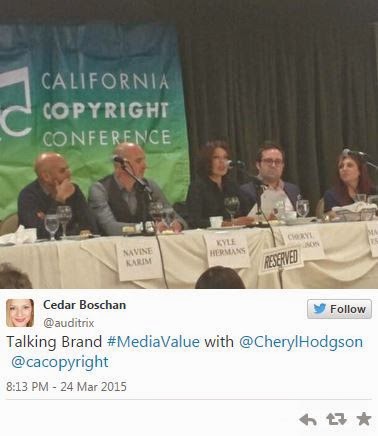
  1. Cheryl Hodgson moderated a fantastic panel discussion about brands and music at the California Copyright Conference:
    Pictured L-R: Navine Karim - Legal Counsel, Red Bull Media House; Kyle Hermans - Brand Innovation, Gap Brands; Cheryl Hodgson - Music Attorney and Founder of Brandaide; Marshall Eskowitz - Marketing Executive, Creative Artist Agency
  2. By David Oxenford, who represents #broadcasters: Songwriter' Equity Act Reintroduced - What Does It Propose?
  3. Hollywood Reporter: We nominated our favorite power lawyers! 
  4. Daily Mail Online: Jay-Z to pay Swiss jazz musician 50% of royalties after 'stealing' his instrumental for 'Versus'
  5. Fast Company: Spotify Unveils A Bold New Brand Identity
  6. New York Post: Spotify to spend $1B on renewal deal with Universal Music

  7. Billboard: 'Blurred Lines' Trial Verdict: Jury Rules Against Pharrell Williams & Robin Thicke
  8. Disruptive Competition Project: Transparency at the Intersection of Music Licensing and Antitrust
  9. Sonicbids: 5 Not-So-Obvious Revenue Streams for Musicians
  10. Digital Music News: 12 Reasons to Fire Your Bandmates

Sunday, February 22, 2015

Top Tweets YTD from the Auditrix 2015 Twitter Feed

Below are the popular tweets from the Auditrix twitter feed, which focuses on music economics and royalties, during 2015 YTD:

Best Unfinished Twitter Conversation with Glenn Peoples @ Billboard and John Strohm @ Loeb

Saturday, December 13, 2014

Listen Here

The Auditrix on music and game royalties:

 MusicBizCast with Kelly Castor Episode 29 with Cedar Boschan
Music Royalties - Audio Interview of Cedar Boschan by Kelly Castor - #Free on MusicBizCast

Royalty Audits: What You Need to Know - International Game Developers' Association (IGDA) Webinar: Distinguished Lawyer Tom Buscaglia Interviews Cedar Boschan - #Free on YouTube

Video Game Dealmaking: Playing to Win (DVD): The Beverly Hills Bar Association Panel Discussion with International Legal and Business Professionals (Receive 1 Hour CLE Credit, $179).  Cedar Boschan Moderates:

Royalty Income Meets Marital Dissolution: Dividing, Managing & Accounting (DVD) @ The Beverly Hills Bar Association (Receive 1 Hour CLE Credit, $179), Featuring Presenters:

Business Managers Brainstorm on Royalties - SXSW and Association of Independent Music Publishers Panel Discussions (@AIMPorg video #free for #membersonly) Featuring:


Saturday, October 18, 2014

Highlights from The California Copyright Conference's October 2014 Music Royalties Dinner

Last week, the California Copyright Conference presented a panel discussion entitled, "Are You Getting Paid? Best Practices for Unmatched Royalties"

October 2014 California Copyright Conference: L-R: Scott Berenson – Director, Claims Department at SoundExchange; Jake Wisely - President The Bicycle Music Company; Diane Snyder Ramirez – Vice President Royalty Accounting & Administration, Royalty Review Council; Chris Castle – Founder, Christian L. Castle, Attorneys, Austin; Anne Cecere – BMI, California Copyright Conference President; Not Pictured: Eric Palmquist - Vice President, Audit & Income Tracking, BMG Chrysalis

I tweeted a few insights from the panelists, such as:


One highlight was when panelist Chris Castle called on Henry Gradstein to speak on state copyright protection of pre-1972 sound recordings:

Henry Gradstein at the California Copyright Conference: Section 980 in California was amended to allow for common law (c) protection

But, a few tweets can't impart all of the valuable information that the panelists shared. To view the complete discussion, click here to join the California Copyright Conference.


#IRespectMusic
Eventually materials from the program will be uploaded here for anyone to access free-of-charge.

Monday, September 7, 2009

Is China Ready to Hold Accountable Infringers of Foreign Copyrights?

China's Ministry of Culture ("MoC") implemented on August 26, 2009 new regulations for online music. In what might be the first in a series of MoC rule changes, online music ventures are now required to obtain MoC approval in order to legally distribute imported online music products in China, including audiovisual files and mobile distributions.

Such new regulations may impact China's 338 million Internet users, as well as search engine and music services in China, including Sohu's SoGou, Alibaba/Yahoo! China, Google and Baidu, which was described in IFPI's 2009 Digital Music Report as "the biggest single violator of music copyrights and by far the greatest obstacle to legitimate digital commerce in China."

Barron's Tech Trader Daily blogger Eric Savitz says analysts disagree on the impact of China's new set of rules on "deep-linking" search engines such as Baidu. Savitz and other bloggers such as Caitlin Cimpanu of Softpedia cite Pali Research analyst Tian Hou's blog report that music searches represent 80% of Baidu’s traffic. Therefore, the new regulations may obligate Baidu to drastically change its business practices by linking only to licensed music services.

On the other hand, Savitz observed:
"UBS analyst Wenlin Ly... says Baidu believes the worst case scenario would be to remove the MP3 search button from its main page ... [and] MP3 search is now under 10% of query traffic."
The true Baidu music search traffic figures may fall between Hou and Ly's estimates. Leena Rao of Tech Crunch reported:
"According to comScore, Baidu had 145 million unique visitors in July of 2009 worldwide (with more than 95 percent of those coming from Asia), while its MP3 search engine attracted 47 million uniques, which is only 32 percent but still significant. For July, Baidu was ranking fifth amongst most visited search engines worldwide, behind Google, Yahoo, Bing and Ask.com."
Whatever the figures, music search and "deep links" compelled Baidu to become a licensed online music service when it obtained from the MoC a newly required "Internet culture license," according to spolkspeople for both the MOC (see the JLM Pacific Epoch blog) and Baidu (see the Wall Street Journal).

We must wait to see whether search engines such as Baidu comply voluntarily with other new MoC regulations, and whether China enforces such regulations in 2010. As The Wall Street Journal pointed out, the MoC is not responsible for enforcing copyright protection.

In the meantime, I endeavored to analyze Google's English translation of the MoC's Chinese language document dated September 4, 2009. [Is there an English language statement from the MoC of which I have failed to locate a copy?] According to my haphazard analysis of the Google-translated MoC document, online music services - including Baidu's deep linking service - must:

(a) Subject content to MoC "Internet Literary Review" with the goal of "purifying the online music market in China" by "strengthening the ban on obscenity, pornography, violence, superstition, and undermining national customs and other harmful social morality music"

(b) Submit "signed import contracts (agreements)" for MoC verification of compliance with "strict requirements" (e.g., "the authorization period of imported network music should be more than one year"). Such contracts which are not directly signed by Mainland China businesses are invalid.

(c) Deem online music from Hong Kong China, Macao Special Administrative Region and Taiwan to be imported

(d) Submit for MOC review by December 31, 2009 imported music that was previously distributed online in China

The MoC is now ambitiously obliged to review during the next four months untold multitudes of content including lyric translations for hundreds of thousands of songs, as well as license agreements and other documents. Is this possible? As one who analyzes music licenses professionally, I suspect China may underestimate the tasks at hand: censoring content and vetting worldwide copyright ownership and license agreements. Therefore, the process will continue well beyond 2010 and/or it will be unthorough.

In addition to announcing the new regulations described above, the MoC saught to:
  1. Further clarify the definition of "online music" as:
    (a) "music products" that are "not material entities..." and are "...digitally transmitted through the information network..." which includes "...the Internet, mobile communications network, the fixed communications network can be achieved via a variety of interactive, real-time communication, sharing of common information network."

    (b) including "not only the usual sense of the songs, music and other forms of digital music products, but also ... the content of the performance of music accompanied by images of the MV [music videos], Flash and so on."

  2. Set forth innovative and clear review procedures and requirements
    (a) The MoC introduced an online music registration system through which online music ventures may request MoC approvals

    (b) The MoC offers a "rapid 'review of access' system" to provide expedited 3-day approvals in certain cases

    (c) The MoC has adopted certain procedures to eliminate duplicate reviews of music content

  3. Clarify the responsibilities of online music ventures:
    (a) "The enterprise must establish a system of self-examination"

    [As an auditor, I caution the MoC against relying solely on music service ventures like Baidu to comply voluntarily with MoC regulations.]

    (b) "Users [who]... upload their own innovations of the network and performing music is not" subject to content review... "Domestic online music business units, especially in providing Internet users create their own compilation and performing services such as online music upload business units should be strictly in accordance with 'Interim Provisions on Administration of Internet Culture,' the provisions of Article XVII of the online music content to enhance the review, ensure that the provision of the legality of online music content." [sic]
This leaves me with dozens of questions, such as:
  • How do you think China's new rules will change the music market?
  • Will reportedly legal Chinese music services like Orca Digital and Google's Top100.cn become profitable?
  • Will Google China increase its search market share dramatically?
  • Will foreign territorries such as Hong Kong, Taiwan and the USA collect billions of dollars in copyright royalty payments from China?
  • Will Baidu and other reported purveyors of unlicensed music find a way around the new regulations?
  • If you are a music copyright holder, have you any deals directly with China?
  • Does anyone disagree with this on grounds of censorship?
  • Is this a "tax" or "disincentive" for music services to import music?
  • Will fewer regulations stimulate demand for domestic Chinese music?
  • What is popular in China's music markets?
The posts on this blog confer no rights or warranties. The opinions expressed on this site are my own and may not represent those of my firm. © 2009, Cedar Boschan. To request permission to reproduce, please contact boschan@royaltyauditors.com.